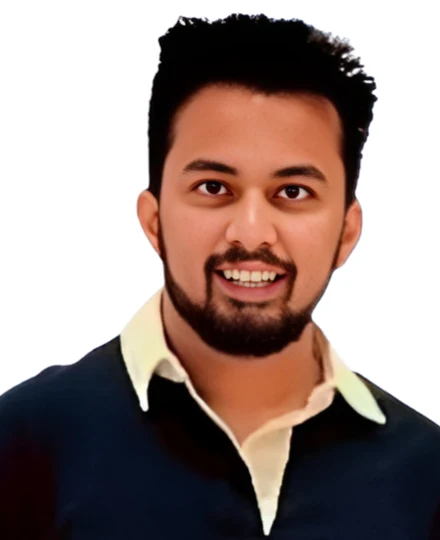
I am Bhanu, a Ph.D. candidate in Computer Science at the University of Missouri, advised by Prof. Tanu Malik in the Radiant Lab. I study whether we can trust what AI systems produce, from hallucinations in language models to the reproducibility of code written by AI agents, and I build benchmarks to measure and evaluate them.
Over the past few years, I found my footing as a researcher thanks to some wonderful people. Most recently, I spent a summer at Microsoft in Redmond as a Research Data Science Intern, working with Anqi and Arturo on the Windows Data team. Before that, I worked with Jack Cheng and Grant Scott, and spent a stretch in the PAAL lab on remote sensing and AI for agriculture. My master's at Mizzou ended with the Outstanding Master's Student Award, which encouraged me to stay on for my Ph.D.
I have been fortunate to receive the EECS Graduate Travel Fellowship and a Chameleon Cloud Travel Award, and to be one of three students Mizzou nominated for the Google PhD Fellowship. My work is supported by NASA AIST, NSF and DoD ERDC. I review for top AI and systems venues such as NeurIPS, where I received an Outstanding Reviewer Award, and serve on program and artifact evaluation committees; see Service.
Outside of research, I build LearnLLM.dev, where people learn to build with large language models, and I am a teaching assistant for Designing End-to-End ML Systems at Mizzou, after two years as a teaching assistant for Web Development.
 Available full-time from mid-2027
News
All updates- 10/2026New!📄 Our paper How Many Labels Does a Language Need? with Sowmya Guda and Navya Vangala was accepted as an oral at the Africa in AI Affinity Workshop at NeurIPS 2026! We study annotation budgets and cross-lingual pooling for African-language text classification.
- 09/2026New!📄 Our paper One Threshold Does Not Fit All Languages with Navya Vangala was accepted as an oral at the Global South in AI Workshop at NeurIPS 2026! We show that each low-resource language needs its own rule for when a model should answer and when to hand off to a human.
- 08/2026🧑🏫 This fall I am a teaching assistant for Designing End-to-End ML Systems at Mizzou, building hands-on labs on Chameleon Cloud and marimo notebooks.
- 08/2026💼 Wrapped up my summer as a Research Data Science Intern at Microsoft in Redmond on the Windows Data team, working with Anqi Cheng and Arturo Herrera.
- 2026📄 Our paper CAMP: Consumption-Aware Memory Prediction for Scientific Workflows got accepted at WORKS at SC26, the International Conference for High Performance Computing. Check out the paper and code.
- 07/2026🎤 Presented Pick and Spin as an oral at IEEE CLOUD 2026 in Sydney, Australia.
- 07/2026🎤 Presented AI-Generated Code Is Not Reproducible (Yet) as an oral at ACM REP 2026 at TU Delft, Netherlands.
- 2026🏆 Selected for the Top 100 at the ACM Doctoral Summit.
Experience
Full CV
MicrosoftRedmond, WA, USA
Research Data Science Intern · with Anqi Cheng · Manager: Arturo Herrera
- Built TempFE, a temporal feature framework for Windows retention telemetry; improved model PR-AUC by 30%.
- Designed a pre-registered six-arm benchmark in which the feature model outperformed TCN and TFT baselines.

University of MissouriColumbia, MO, USA
Graduate Research Assistant · with Tanu Malik (Radiant Lab) and Jianlin Cheng
Supported by  NASA AIST
 NSF
NSF DoD ERDC
- Built cold-start-aware LLM routing and orchestration; reduced GPU-hours by 46% over 310K+ inference runs.
- Built a three-layer dependency audit across 1,000 runs, three agents, and four languages.

LearnLLM.devRemote
Founder
- Built and maintain an LLM education platform with an active user base using Next.js, TypeScript, and Supabase.
Precision and Automated Agriculture Lab, University of MissouriColumbia, MO, USA
Graduate Research Assistant
- Built AI pipelines for UAV remote-sensing imagery; improved geospatial accuracy by 40% in UAV workflows.

Adobe ResearchIndia
Volunteer Research Intern
- Delivered quality-controlled scraping pipelines for research datasets.
Education
University of MissouriColumbia, MO, USA
Doctor of Philosophy (Ph.D.) in Computer Science
- Dissertation: Executable Reliability: Unifying Trust, Reproducibility, and Efficiency in LLM-Based Systems.
- Advised by Prof. Tanu Malik (Radiant Lab).
- Google PhD Fellowship Nominee (NLP track, 2025); EECS Graduate Travel Fellow (2026).
University of MissouriColumbia, MO, USA
Master of Science (M.S.) in Computer Science
- Thesis: Deploying LLMs as a Service in Kubernetes HPC Clusters.
- Advised by Prof. Grant J. Scott and Prof. Jianlin Cheng.
- Outstanding Master’s Student Award (2025); Runner-up, MUIDSI Hackathon (2025).

Vellore Institute of TechnologyIndia
Bachelor of Technology (B.Tech.) in Computer Science and Engineering with Specialization in Data Analytics
- Thesis: Multilingual Sentiment Analysis on KOO User Posts.
- Advised by Dr. Soubhagya Barpanda; KOO datasets and API access supported by Prof. Ponnurangam Kumaraguru.
- Dean’s Research Excellence Award (2023); Top-2 Academic Performer (2022); Merit Scholarship.
Publications
Full publication listPublished & accepted · 10 papers
-
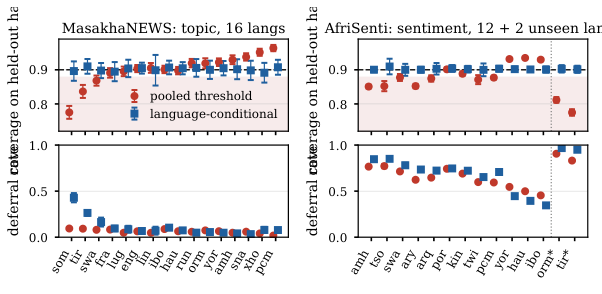
One Threshold Does Not Fit All Languages: Language-Conditional Deferral for Reliable and Efficient Low-Resource Text Classification
 Global South in AI Workshop at NeurIPS 2026 Oral
@misc{vangala2026thresholddoesfitlanguages, title={One Threshold Does Not Fit All Languages: Language-Conditional Deferral for Reliable and Efficient Low-Resource Text Classification}, author={Bhanu Prakash Vangala and Vangala Navya}, year={2026}, eprint={2609.37861}, archivePrefix={arXiv}, primaryClass={cs.CL}, url={https://arxiv.org/abs/2609.37861}, } -
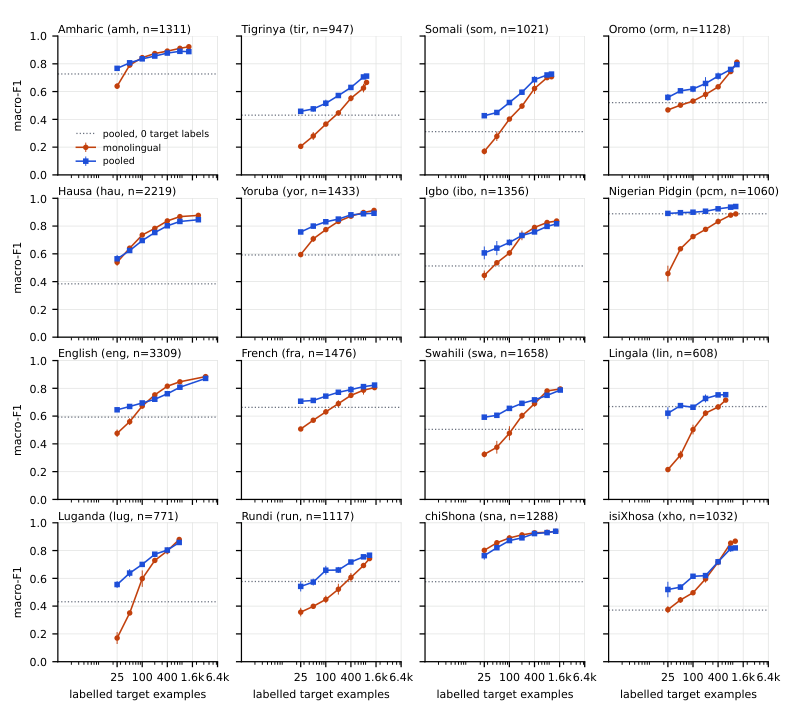
How Many Labels Does a Language Need? Annotation Budgets and Cross-Lingual Pooling for African-Language Text Classification
Africa in AI Affinity Workshop at NeurIPS 2026 Oral@misc{vangala2026labelsdoeslanguageneed, title={How Many Labels Does a Language Need? Annotation Budgets and Cross-Lingual Pooling for African-Language Text Classification}, author={Bhanu Prakash Vangala and Sowmya Guda and Navya Vangala}, year={2026}, eprint={2609.37882}, archivePrefix={arXiv}, primaryClass={cs.CL}, url={https://arxiv.org/abs/2609.37882}, } -
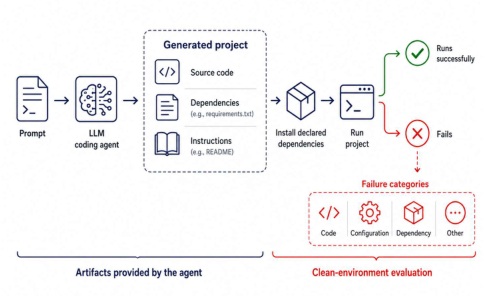
AI-Generated Code Is Not Reproducible (Yet): An Empirical Study of Execution Reliability in LLM-Based Coding Agents
 ACM REP 2026 Oral
@inproceedings{vangala2026aigeneratedcodeexecution, author = {Vangala, Bhanu Prakash and Gehani, Ashish and Malik, Tanu}, title = {AI-Generated Code Is Not Reproducible (Yet): An Empirical Study of Execution Reliability in LLM-Based Coding Agents}, booktitle = {Proceedings of the 4th ACM Conference on Reproducibility and Replicability}, series = {ACM REP '26}, publisher = {ACM}, year = {2026}, month = jul, pages = {33--46}, doi = {10.1145/3820002.3828581}, url = {https://doi.org/10.1145/3820002.3828581} } -
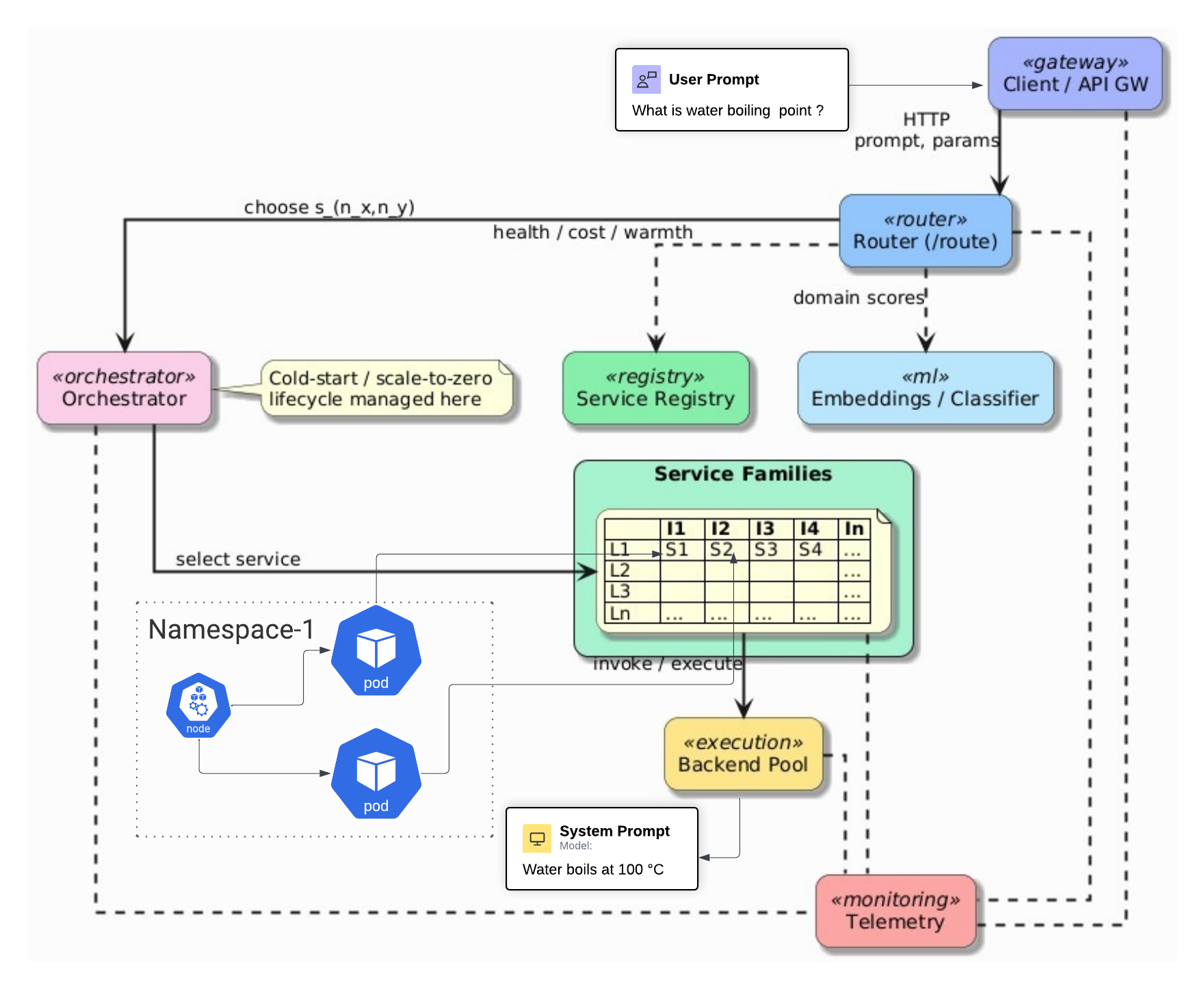
Pick and Spin: Cold-Start-Aware Routing for Self-Hosted LLM Serving
 IEEE CLOUD 2026 Oral
@inproceedings{vangala2026pickspin, author = {Vangala, Bhanu Prakash and Malik, Tanu}, title = {Pick and Spin: Cold-Start-Aware Routing for Self-Hosted LLM Serving}, booktitle = {2026 IEEE 19th International Conference on Cloud Computing (CLOUD)}, publisher = {IEEE}, year = {2026}, month = jul, pages = {388--394}, doi = {10.1109/cloud72782.2026.00050}, url = {https://doi.org/10.1109/cloud72782.2026.00050} } -
-
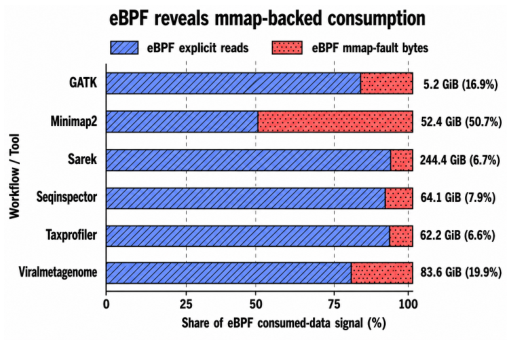
AI-Generated Code Is Not Reproducible (Yet): An Empirical Study of Dependency Gaps in LLM-Based Coding Agents
 RAI Workshop at AAAI 2026 Oral
@misc{vangala2026aigeneratedcodereproducibleyet, title={AI-Generated Code Is Not Reproducible (Yet): An Empirical Study of Dependency Gaps in LLM-Based Coding Agents}, author={Bhanu Prakash Vangala and Ali Adibifar and Ashish Gehani and Tanu Malik}, year={2026}, eprint={2512.22387}, archivePrefix={arXiv}, primaryClass={cs.SE}, url={https://arxiv.org/abs/2512.22387}, } -
Efficient Multi-Model Orchestration for Self-Hosted Large Language Models
DAI Workshop at AAAI 2026 Oral@misc{vangala2025efficientmultimodelorchestrationselfhosted, title={Efficient Multi-Model Orchestration for Self-Hosted Large Language Models}, author={Bhanu Prakash Vangala and Tanu Malik}, year={2025}, eprint={2512.22402}, archivePrefix={arXiv}, primaryClass={cs.DC}, url={https://arxiv.org/abs/2512.22402}, } -

HalluMat: Detecting Hallucinations in LLM-Generated Materials Science Content Through Multi-Stage Verification
AAAI Spring Series 2025, AI for Engineering and Scientific Discoveries Oral@misc{vangala2025hallumatdetectinghallucinationsllmgenerated, title={HalluMat: Detecting Hallucinations in LLM-Generated Materials Science Content Through Multi-Stage Verification}, author={Bhanu Prakash Vangala and Sajid Mahmud and Pawan Neupane and Joel Selvaraj and Jianlin Cheng}, year={2025}, eprint={2512.22396}, archivePrefix={arXiv}, primaryClass={cs.AI}, url={https://arxiv.org/abs/2512.22396}, } -

-


Submitted & under review
Manuscripts currently under review.
-
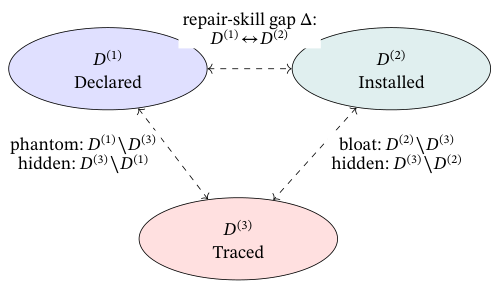
Code That Works, Environments That Don’t: Measuring Environment Reproducibility in AI-Generated Software
AI Magazine — Special Issue on AI and Reproducibility (AAAI · Wiley) Under reviewNext version in progress: a public benchmark that tests how reliable code from AI coding agents really is, covering reproducibility, environment instability and dependency security. View the benchmark
@misc{vangala2026codeworksenvironmentsdont, title={Code That Works, Environments That Don't: Measuring Environment Reproducibility in AI-Generated Software}, author={Bhanu Prakash Vangala and Tanu Malik}, year={2026}, eprint={2610.00425}, archivePrefix={arXiv}, primaryClass={cs.SE}, url={https://arxiv.org/abs/2610.00425}, } -

Evaluation Choices Shape Biomedical ML Claims: A Pediatric Pneumonia Benchmark Case Study
RCMLR Workshop at NeurIPS 2026 Under review@misc{vangala2026evaluationchoicesshapebiomedical, title={Evaluation Choices Shape Biomedical ML Claims: A Pediatric Pneumonia Benchmark Case Study}, author={Bhanu Prakash Vangala and Sowmya Guda and Latha Peddi and Navya Vangala}, year={2026}, eprint={2609.37848}, archivePrefix={arXiv}, primaryClass={cs.CV}, url={https://arxiv.org/abs/2609.37848}, } -
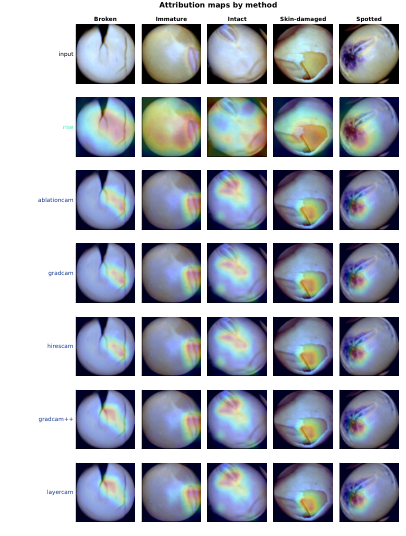
AI Sees, XAI Explains? Evaluating Explanation Reliability in Automated Seed Quality Inspection
 Computers and Electronics in Agriculture (Elsevier · ScienceDirect) Under review
@misc{vangala2026aiseesxaiexplains, author = {Vangala, Bhanu Prakash and Vangala, Navya}, title = {AI Sees, XAI Explains? Evaluating Explanation Reliability in Automated Seed Quality Inspection}, year = {2026}, howpublished = {SSRN}, note = {Available at SSRN: https://ssrn.com/abstract=7544801}, doi = {10.2139/ssrn.7544801}, url = {https://doi.org/10.2139/ssrn.7544801} } -
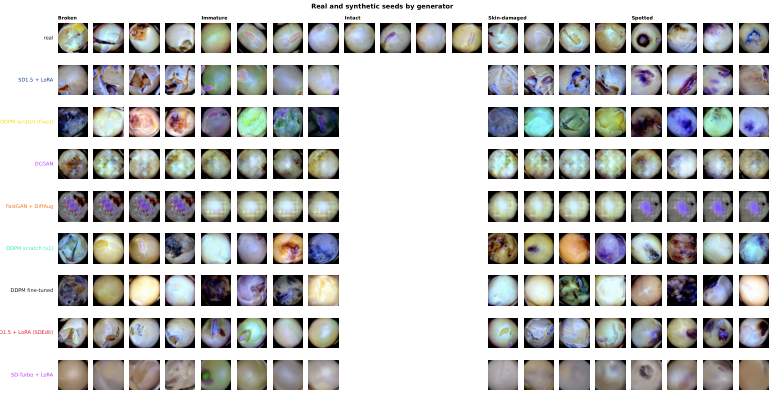
Visual Realism Does Not Predict Seed-Quality Utility in AI-Generated Synthetic Seeds
Artificial Intelligence in Agriculture (KeAi / Elsevier · ScienceDirect) Under review -
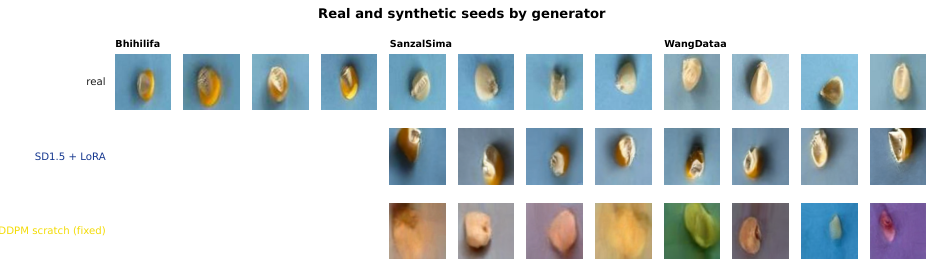
AI-Generated Seed Images Do Not Outperform Matched Reuse of Scarce Real Defect Images in Seed Quality Assessment
 Scientific Reports (Nature Portfolio · Springer Nature) Under review
 -

Scores That Hold, Benchmarks That Leak: Measuring Dataset Contamination in Public Brain-Tumor MRI Classification
IEEE Journal of Biomedical and Health Informatics (IEEE · IEEE Xplore) Under review@misc{vangala2026scoresholdbenchmarksleak, title={Scores That Hold, Benchmarks That Leak: Measuring Dataset Contamination in Public Brain-Tumor MRI Classification}, author={Bhanu Prakash Vangala and Sowmya Guda and Latha Peddi and Navya Vangala}, year={2026}, eprint={2610.00421}, archivePrefix={arXiv}, primaryClass={cs.CV}, url={https://arxiv.org/abs/2610.00421}, }
In preparation
-
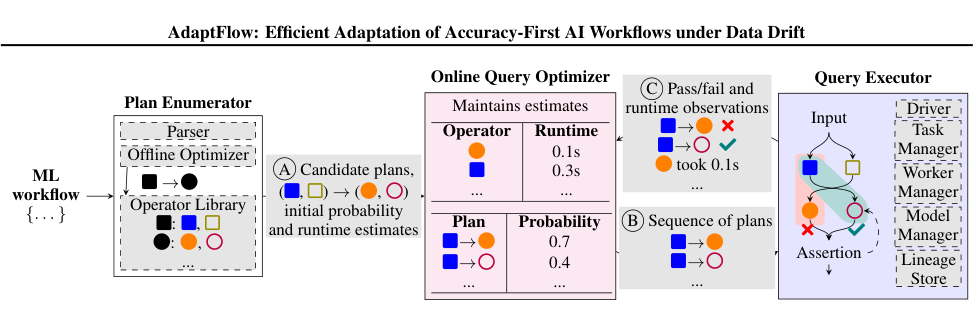
AdaptFlow: Efficient Adaptation of Accuracy-First AI Workflows under Data Drift
 Intended venue: MLSys 2027 In preparation
Posters & presentations
-

Adaptive Inference: Orchestrating Fine-Tuned LLMs with Serverless GPUs in HPC Environments
University of Missouri Poster
Earlier work
All projects
Coursework projects
All courseworkHonors & awards
- Top 100, ACM Doctoral Summit · Association for Computing Machinery2026
- Chameleon Cloud Travel Award · Top 10 proposals, NSF Chameleon Cloud2026
- EECS Graduate Travel Fellowship · University of Missouri2026
- Outstanding Reviewer Award · AI4Mat Workshop, NeurIPS 20252025
- Google PhD Fellowship Nominee · NLP track, University of Missouri2025
- Outstanding Master’s Student Award · University of Missouri · Photos & post2025
- Runner-up, Generative AI for Social Good Hackathon · IBM / MUIDSI · Photos & post2025
- Dean’s Research Excellence Award · Vellore Institute of Technology2023
Talks & presentations
- OralPick and Spin: Cold-Start-Aware Routing for Self-Hosted LLM Serving
IEEE CLOUD 2026, Sydney, Australia · Photos & postJul 2026 - OralAI-Generated Code Is Not Reproducible (Yet): An Empirical Study of Execution Reliability in LLM-Based Coding Agents
ACM REP 2026, Delft, Netherlands · Photos & postJul 2026 - Selected talkEvaluating Dependency Gaps in LLM-Generated Code
Sixth Chameleon User Meeting, NCAR Mesa Lab, Boulder, CO · Slides · Photos & postApr 2026 - SeminarMINDFUL Seminar
Invited seminar talk at University of MissouriMar 2026 - OralAI-Generated Code Is Not Reproducible (Yet)
RAI Workshop at AAAI 2026, Singapore · Photos & postJan 2026 - OralEfficient Multi-Model Orchestration for Self-Hosted LLMs
DAI Workshop at AAAI 2026, Singapore · Photos & postJan 2026 - TalkHallucination Detection in Scientific LLMs (HalluMat and HalluFormer)
AAAI Spring Series 2025, AI for Engineering and Scientific Discoveries · Photos & postApr 2025
Teaching
Designing End-to-End ML SystemsUniversity of Missouri
Teaching Assistant
- Designing hands-on labs on Chameleon Cloud and marimo notebooks.
Web Development (MERN Stack)University of Missouri
Teaching Assistant
- Mentored 115+ students.
Service
Program committees
Conference reviewing
- Conference on Neural Information Processing Systems (NeurIPS) 2026
- International Conference on Parallel Architectures and Compilation Techniques (PACT) 2026
- IEEE International Conference on Big Data (IEEE Big Data) 2025
- ACM International Conference on Information and Knowledge Management (CIKM) 2025
Workshop reviewing
- Responsible Communication of ML Research in Biomedicine (RCMLR) Workshop at NeurIPS 2026
 GlobalSouthCV Workshop at BMVC 2026
- AI for Accelerated Materials Design (AI4Mat) Workshop at NeurIPS 2025 🏆 Outstanding Reviewer Award
 AI for Accelerated Materials Design (AI4Mat) Workshop at ICLR 2025
Journal reviewing
- Journal of Computer Languages (Elsevier)
Artifact evaluation committees
- Conference on Neural Information Processing Systems (NeurIPS) 2026
- International Conference on Parallel Architectures and Compilation Techniques (PACT) 2026
- ACM Conference on AI and Agentic Systems (CAIS) 2026 (committee)
University organizations
- College of Engineering Graduate Student Association (CEGSA), University of Missouri: EECS Department Representative, Leadership Team
- Cultural Association of India (CAI), University of Missouri: Active member